Eggplant Disease Treatment
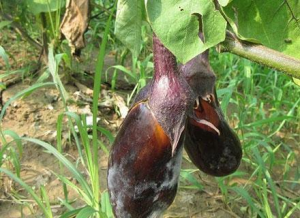
1. Eggplant Phytophthora Rot
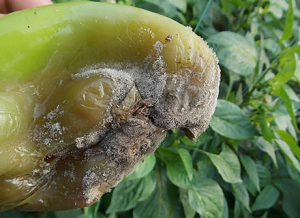
Eggplant Phytophthora Rot caused Phytophthora capsici. This soil-inhabiting organism causes root rot in pepper and eggplant and is most active in moist, warm weather (75°F to 91°F). Disease is generally seen in the wettest areas of a field.
Symptoms:
Symptoms from dark-gray to dark-brown, water-soaked spots develop on roots and stems, causing plants to wilt and die. Leaf spots develop, which are initially gray-to-brown in color, water soaked in appearance, and irregularly shaped, later becoming light brown. Fruit show similar spots, often enlarging to cover the entire fruit, which later dries and mummifies. Whitish sporulation may develop on infected fruit.
2. Eggplant Phomopsis Blight
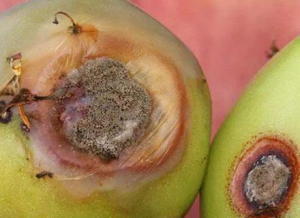
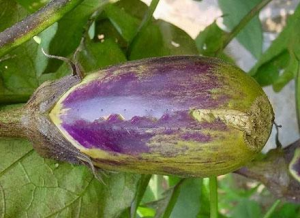
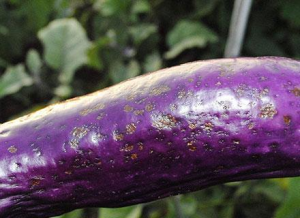
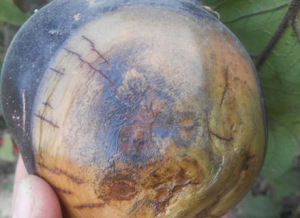
Eggplant Phomopsis blight caused by P.vexans. Easily seedborne and producing large numbers of conidia, it causes disease in eggplant, its only significant host. This ranges from poor seed germination and damping-off of seedlings to leaf and stem lesions and to fruit rot, both in the field and after harvest.
Symptoms:
The symptoms range from poor germination and seedling blight to fruit rot.
The symptoms on leaves are more prominent during the early stages of plant growth. At first the lesions are small, more or less circular, and buff to olive, later becoming cinnamon buff, with an irregular blackish margin.
On stems and branches, elongated, blackish-brown lesions are formed, eventually containing pycnidia.
On the fruits the symptoms appear first as minute sunken greyish spots with a brownish halo, which later enlarge and coalesce, producing concentric rings of yellow and brown zones.
3. Eggplant Gray Mold
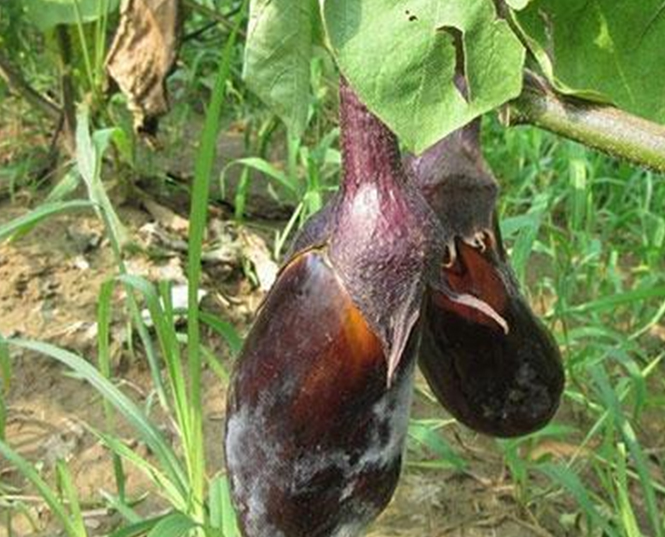
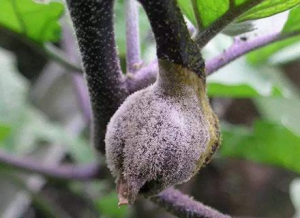
Gray mold (Botrytis cinerea) cause by Botrytis cinerea Pers. It is a common fungus disease on eggplants, it can reduce the production by 20-30% at worse. Most disease infestations are not evenly distributed across the cultivation area but in patches.
Symptoms:
Eggplant Gray mold can occur at the seedling and adult stages. When the seedling is infected, the apex of the cotyledon dies, and then the fungus expands on the young stem, causing the young stem to constrict and become thinner, and often break off from the diseased part. The disease occurs at the adult stage, mostly from the withered petals, and gray mold spots are formed on the petals, and then invade the young fruit, causing the young fruit to rot. The surface produces irregularly striated gray mold. The leaves are infected with V-shaped lesions from the tip to the inside, which are water-soaked at first, with inconspicuous edges, and then light brown to yellowish brown. When the humidity is high, gray mold layers are densely formed on the lesions.